
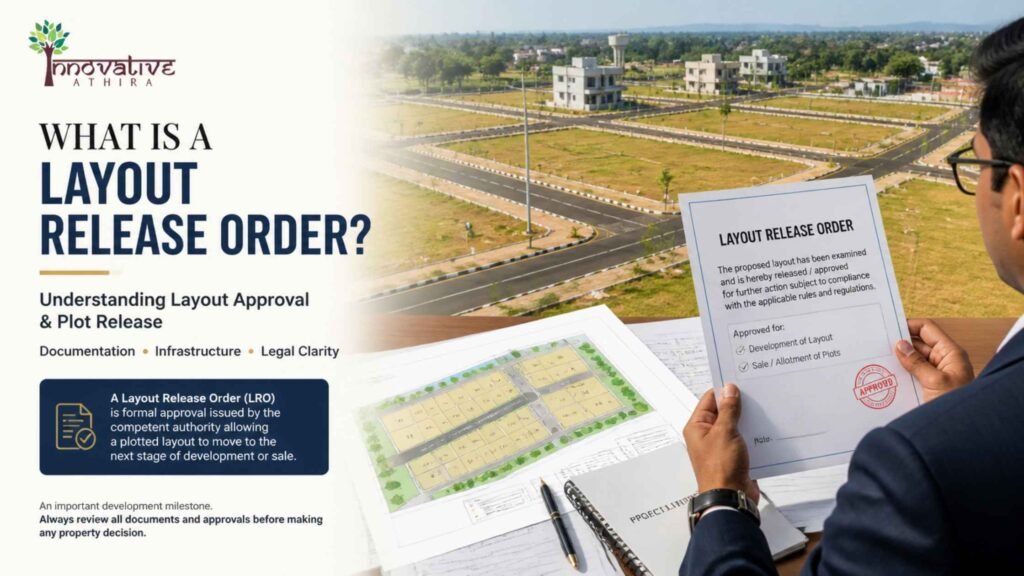
A layout release order is a document issued by the relevant authority that permits specified plots in an approved layout to be released for sale or other permitted transactions, subject to the order’s terms. For a buyer, the important point is not merely whether an order exists, but whether it covers the particular plot being considered.
If you are exploring a plot near BIEC, Madavara, Nagasandra or Nelamangala, understanding this document can help you ask better questions before committing money.
What a layout release order means for a buyer
A release order is best understood in relation to the development process. An authority may approve a layout plan subject to conditions, such as completing specified infrastructure or complying with other planning requirements. A subsequent release document can identify plots that have been cleared for the transactions permitted under that document.
Depending on the applicable rules, approval conditions and project stage, plots may be released in phases rather than all at once. The document’s title, format and conditions can also vary between authorities and projects. Read the actual order rather than assume that every release follows the same pattern.
For example, a layout might have a sanctioned plan showing several numbered plots. If the relevant release order covers only some of those plots, the presence of a different plot on the sanctioned drawing does not, by itself, establish that the plot has been released. Ask for the order and any annexure or plot schedule, then check the precise plot number and conditions.
A release order is useful evidence, but it is not a substitute for examining ownership, title, encumbrances, land-use permissions and the sale documents.
Layout approval and plot release
Layout approval generally concerns the authority’s acceptance of a development plan, subject to its conditions. Plot release addresses whether specified plots have been cleared for the transactions allowed by the relevant order. The two documents serve different purposes, and one should not be assumed to replace the other.
| Document or check | What it helps establish | What to examine next |
|---|---|---|
| Sanctioned layout plan | The approved arrangement of plots, roads and other designated spaces, subject to the plan’s conditions. | Confirm the latest approved version and whether the chosen plot appears on it. |
| Release order | Which plots have been released and what conditions apply to that release. | Match the plot number and review the order and its annexures. |
| Title documents | The basis on which the seller or developer claims rights over the land. | Have an independent property lawyer examine ownership and the chain of title. |
| Encumbrance certificate (EC) | Relevant registered transactions reflected in the records for the period searched. | Check the period, property details and other records; an EC alone does not establish clear title. |
| Real Estate Regulatory Authority (RERA) registration, where applicable | Project registration and disclosures available through the relevant RERA portal. | Check the project’s registration status, disclosed details and applicable exemptions. |
A brochure may describe a project as approved, but that description does not explain every condition attached to it. Ask which authority issued the approval, what it covers, whether it remains applicable and whether any revisions have been made.
Why check the release order early?
Checking the order early can reveal a mismatch between the plot offered and the plots listed for release. It also gives your lawyer an opportunity to review the conditions before you sign an agreement or pay a substantial advance.
A site may suit your budget and have attractive access, but those features do not establish what has been approved or released. An unresolved document issue could affect registration, financing or building plans. Early verification cannot eliminate every risk, but it gives you a clearer basis for deciding whether to proceed.
Which authority’s records should you check around Bangalore?
The authority to check depends on the property’s exact location and the powers applicable to that project. Civic administration, planning jurisdiction and layout approval are related but not always identical functions, so a locality name or postal address alone is not enough to establish the issuing authority.
The Bangalore Development Authority (BDA) may be relevant to planning approvals in some areas. Other locations may fall under a different competent planning authority. Properties on the Nelamangala side may be within the wider Bangalore Metropolitan Region, where the Bangalore Metropolitan Region Development Authority (BMRDA) framework or a relevant local planning authority may be involved.
Within areas administered by the Bruhat Bengaluru Mahanagara Palike (BBMP), municipal records and civic permissions can be relevant. However, being within municipal limits does not automatically make BBMP the authority that sanctioned a particular layout or issued its release order. Administrative boundaries and responsibilities can change.
Ask for the survey numbers, village, taluk, approval reference and name of the issuing authority. Use those details to check with the relevant office or portal. The actual land location matters more than a marketing description.
Useful official starting points include:
- Bangalore Development Authority for information about BDA services and records.
- Bangalore Metropolitan Region Development Authority for information about the metropolitan planning framework.
- Karnataka RERA portal for project registration and disclosures, where applicable.
- Kaveri Online Services for Karnataka registration services, including EC searches.
Not every release order or approval will be available through these portals. If a record is not online, contact the issuing authority for its verification procedure.
Layout approval documents to review
The documents needed depend on the land, project and applicable authority. A review should connect the land’s ownership and permitted use with the sanctioned layout and the plot being sold.
- Sanctioned layout plan: Check the approval reference, survey numbers, plot dimensions, access roads and any designated common or public spaces.
- Layout approval order and conditions: Read the conditions attached to the sanction, not just the drawing.
- Release order and annexures: Identify the plots covered, any phase-wise release and conditions relevant to registration or sale.
- Land-use and conversion records: Review applicable conversion orders and planning permissions, including conditions that may affect development.
- Title and ownership records: Examine the chain of title, supporting land records and the seller’s authority to enter into the transaction.
- Encumbrance and charge information: Check registered transactions and investigate mortgages, claims or release of charges where relevant.
- RERA information, if applicable: Compare the project and promoter details with disclosures on the Karnataka RERA portal.
- Draft agreement and sale deed: Ensure the plot description, dimensions, consideration and agreed obligations match the verified records.
The list is a starting point, not a legal opinion. Additional records may be necessary for inherited land, joint development arrangements, powers of attorney, boundary discrepancies or other circumstances specific to the property.
Verifying the approved layout status of a plot
Start with the plot number and work backwards to the land and authority records. A project name alone may not be enough: a layout can have revisions, phases or multiple survey numbers, and a document relating to one portion may not automatically cover another.
- Identify the property. Obtain the plot number, dimensions, survey numbers and location details from the seller.
- Read the sanctioned plan. Locate the plot and compare its boundaries, dimensions and access with the site and proposed sale documents.
- Examine the release order. Check the issuing authority, reference number, date, conditions and plot schedule. Ask whether later orders or revisions exist.
- Verify planning authority records. Use the relevant official portal or approach the issuing office to confirm the documents and their current position.
- Review title and encumbrances. Ask an independent property lawyer to assess the records and identify further searches needed.
- Compare the paperwork with the ground. Where appropriate, engage a qualified surveyor to check boundaries and measurements.
- Confirm the transaction terms. Make sure the agreement and sale deed describe the same plot and reflect the agreed commitments.
If a document is unavailable, unclear or inconsistent with another record, pause and seek clarification. A verbal assurance that a document will be provided later should not replace a satisfactory review before you commit.
What to look for during a site visit
A site visit helps you compare the layout on paper with what exists on the ground. It cannot prove legal compliance on its own, but it can reveal questions about access, boundaries, development work and the suitability of a plot for your plans.
Walk the approach road and locate the plot using the sanctioned plan, rather than relying only on a displayed marker. Observe the width and condition of roads, drainage arrangements, electricity infrastructure and other facilities described by the developer. Ask which features are complete, which are planned and who is responsible for delivering them.
Pay attention to slopes, low-lying areas and neighbouring uses. Check travel times and access for the individual project rather than assuming they reflect the wider locality.
What to confirm before booking
Before paying a booking amount, establish what you are buying, what documents support the offer and what happens if your review raises a concern. Ask for the booking, payment, cancellation and refund terms in writing. Also confirm which infrastructure is complete and which features are promised for a later stage.
These plot legal checks help you understand the property, the paperwork and the commitments on both sides.
Requesting project information
Innovative Developers and Promoters offers plotted development opportunities, including projects in and around North Bangalore. You can ask the team about a particular project’s location, development stage and available documentation, including the records for a specific plot.
To request project information or discuss your requirements, call +91-9986480820 or visit Innovative Developers and Promoters.
This article is general information, not legal advice. No legal or planning reviewer or last verification date has been identified for this article. Approval requirements, authority jurisdiction and document names can vary by property and may change. Verify current records with the competent authority and consult an independent professional before proceeding.
Frequently Asked Questions
What is a layout release order?
A layout release order is generally an order issued by the relevant planning authority allowing specified plots or parts of an approved layout to be released after applicable conditions are met. The terminology and effect vary by location, so read the order alongside the approved plan and any conditions imposed by the issuing authority.
Is a layout release order the same as layout approval?
Not necessarily. Layout approval generally concerns the proposed subdivision and its compliance with planning requirements. A release order may address whether specified plots can be released after further conditions are satisfied. An approval alone should not be assumed to release every plot; check both documents and their conditions.
What should I check in a release order before buying a plot?
Check the issuing authority, order number and date, the land and layout identified, and whether the particular plot is included. Review any conditions, restrictions or references to earlier approvals. Compare these details with the approved layout plan and confirm the order with the authority where possible.
Which other documents should I review?
Ask for the approved layout plan, relevant approval and release orders, title deeds, land-use or conversion permissions where applicable, and current encumbrance and tax records. Requirements differ by jurisdiction. An independent property lawyer can identify the documents needed and check ownership, access, restrictions and discrepancies.
How can I verify whether my plot is covered by an approval or release?
Compare the plot number, survey or land identification details, boundaries and dimensions across the documents. Then check the order and plan with the relevant planning authority, using its official records or verification process. If a layout was released in phases, confirm that your specific plot is included in the applicable phase.
Does a release order guarantee that a plot is safe to buy?
No. A release order does not by itself establish clear ownership or rule out mortgages, disputes, access issues or other restrictions. Have an independent property lawyer review the title and related records, and consider a site inspection or survey before committing to a purchase.
How can Innovative Developers and Promoters help me assess a plot?
Ask Innovative Developers and Promoters for the documents and project details available for the plot you are considering, including the approved plan and any applicable release order. Discuss which plots and development features are covered and what support the company can provide. Verify its current services and obtain independent legal advice before making a decision.
What if the release order is unavailable or the details do not match?
Ask the seller or developer for clarification and supporting documents, and check the details directly with the issuing authority. Do not rely on verbal assurances or assume a discrepancy is harmless. Consult an independent property lawyer before paying a deposit or signing an agreement.