
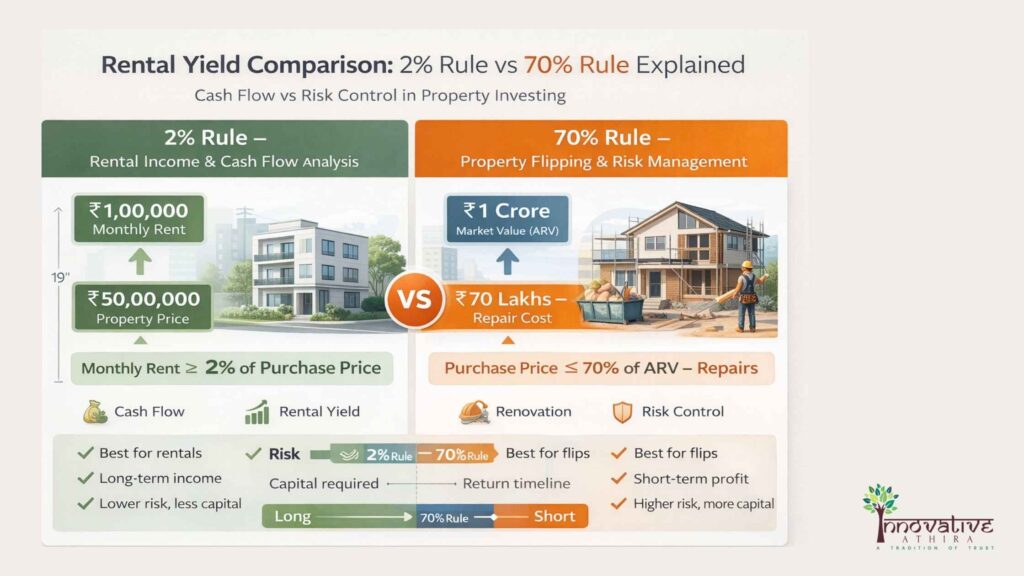
If you’re evaluating real estate for passive income, the simplest way to decide faster is to compare the Rental Yield using two investor shortcuts: the 2% rule and the 70% rule. In one sentence: the 2% rule checks if rent is high enough, while the 70% rule checks if your purchase (or project cost) leaves enough margin after repairs—together they reveal whether a deal is truly investment-grade.
In North Bangalore—especially around BIEC, Madavara, and Nagasandra—the right comparison isn’t theoretical. It is practical, location-driven, and execution-driven. This is where Innovative Developers and Promoters stands apart: by focusing on layouts and plotted development opportunities that align with investor logic, real demand, and realistic exits.
Why investors in North Bangalore are rethinking rental yield decisions
For years, rental property investors have chased “good rent” without factoring in the deeper truth: Bangalore’s most profitable rental decisions are rarely made by guessing. They are made using structured evaluation. That is why a strong rental math comparison matters more today than ever.
North Bangalore has transformed into one of the strongest long-term real estate belts because it supports:
- Large employment hubs and supply-chain activity near BIEC
- Metro connectivity and expanding infrastructure around Madavara and Nagasandra
- Continuous residential demand due to migration, job switches, and rental population growth
- Future-forward development opportunities from plotted layouts to gated communities
Yet, here’s the problem most investors face (and often don’t realize until it’s too late): they buy where “everyone is buying”, not where yields, liquidity, and legal clarity work together. This is where the PAS approach fits perfectly: the pain is poor returns, the agitation is delayed realization (years later), and the solution is structured evaluation— the kind Innovative Developers and Promoters is known for.
What is rental yield and why it matters more than price appreciation
Rental yield is the percentage return you earn annually from rent compared to the property’s value or investment. It becomes the most honest metric in real estate because it answers one powerful question: Is this asset paying me to own it?
Investors often get trapped in appreciation narratives. But appreciation is uncertain, cyclical, and timing-sensitive. Rental yield is monthly, predictable, and helps:
- Offset EMIs and reduce holding pressure
- Support long-term wealth building with lower stress
- Improve resale value since income-producing properties attract buyers
- Strengthen your portfolio using disciplined financial planning
This is exactly why Innovative Developers and Promoters positions projects not only as “plots or layouts,” but as strategic investor assets—especially around North Bangalore micro-markets where supply, infrastructure, and demand overlap.
What is the 2% rule in real estate investing?
The 2% rule is a quick rental benchmark that says: a property is considered attractive if the monthly rent is at least 2% of the purchase price.
How the 2% rule is calculated
Monthly Rent ÷ Purchase Price = monthly yield
Example:
- Property price: ₹50,00,000
- Target rent by 2% rule: ₹1,00,000/month
If rent is significantly lower (say ₹25,000 to ₹35,000), the property fails the 2% benchmark—meaning it might still be a good home, but it may not be a high-yield investment.
In Bangalore, especially premium zones, the 2% rule is difficult to meet. But that doesn’t make it irrelevant. It makes it a powerful filter for identifying pockets where rent demand is unusually high compared to asset price. Some North Bangalore corridors—when chosen correctly—perform better than assumed, particularly for rental-led investors.
What is the 70% rule and why is it used for property flips?
The 70% rule is most often used by investors who buy undervalued properties, renovate them, and sell for profit. It suggests an investor should pay no more than 70% of the after-repair value (ARV), minus repairs.
How the 70% rule is calculated
Maximum Purchase Price = (ARV × 70%) − Repair Cost
Example:
- ARV: ₹80,00,000
- 70% of ARV: ₹56,00,000
- Repair cost: ₹6,00,000
- Maximum purchase: ₹50,00,000
While this is commonly seen in markets like the US, it is increasingly relevant to the investor model India, especially where investors want to build margin protection into their transactions.
In Bangalore, 70% rule thinking is extremely useful even for plotted development and layout decisions—because a layout purchase is also about margin, approvals, and future exit demand. Innovative Developers and Promoters helps investors apply this thinking in a Bangalore-specific manner instead of copying foreign formulas blindly.
Rental yield comparison: 2% rule vs 70% rule (what they really measure)
Many investors ask: “Which rule should I use?” The correct answer is: use both, but for different purposes.
| Parameter | 2% rule | 70% rule |
|---|---|---|
| Primary use | Rental income screening | Margin safety for buying/renovation |
| Investor focus | Cash flow | Profit buffer |
| Best for | Buy-to-rent | Buy-repair-sell or value-add projects |
| Strength | Simple, fast elimination | Strong risk protection |
| Weakness | Hard to meet in premium cities | Requires ARV/repair accuracy |
This is where risk vs reward becomes the core decision lens. Investors don’t lose money only because they pick a bad property. They lose because they pick a property with poor risk structure.
How to apply these rules in Bangalore’s North corridor (BIEC, Madavara, Nagasandra)
The reason these areas deserve special focus is that they represent a rare mix of infrastructure momentum and expanding lifestyle demand. But it’s not enough to “buy in North Bangalore.” It must be bought correctly—with legal clarity, layout approvals, and future marketability.
What makes BIEC region different for investors?
- Event-driven demand influencing short and mid-term rentals
- Warehousing, manufacturing, and ecosystem-driven workforce housing
- Greater preference for well-planned layouts with access roads and utilities
Why Madavara and Nagasandra influence future rental stability
- Metro and transit-driven renter convenience
- Growing family rental base (schools, connectivity, retail)
- Scope for consistent occupancy due to workforce inflow
Innovative Developers and Promoters has strategically executed and is executing projects concentrated in these belts, because rental demand is not accidental here—it is structurally supported.
Why approvals and jurisdictions change your returns (BMRDA vs BDA vs BBMP)
Most investors don’t realize this: legal jurisdiction affects liquidity, perception, and buyer confidence—directly impacting yield, resale timelines, and even bankability.
- BBMP applies to layouts within Bangalore city limits
- BDA commonly applies near established planned regions and areas closer to key city expansion corridors (including near BIEC zones)
- BMRDA applies to outskirts and satellite zones such as Nelamangala
When your goal is optimizing yield, you want predictable approvals, predictable market confidence, and fewer legal obstacles. Innovative Developers and Promoters structures its offerings with clear understanding of these jurisdiction realities so your investment thesis does not collapse due to compliance confusion later.
What smart investors do differently: they don’t “hope”—they model
A disciplined investor does not buy on emotion; they buy on repeatable frameworks. That is the heart of modern financial planning for real estate.
Key inputs investors must model before choosing a layout or rental asset
- Total acquisition cost (including registration, interiors/repairs if any)
- Expected rent and realistic occupancy rate
- Maintenance, property tax, and ongoing costs
- Exit value realism (not marketing projections)
- Regulatory confidence (BMRDA/BDA/BBMP context)
This is where Innovative Developers and Promoters becomes more than a developer: it becomes a strategic partner aligned with investor-grade decisioning. Their on-ground project focus in North Bangalore also gives you the advantage of choosing from locations where the next cycle of growth is already forming.
How Innovative Developers and Promoters maximizes investor advantage in North Bangalore
Innovative Developers and Promoters is a real estate development and promotion brand based in Bangalore, specializing in plotted development, layout planning, and investor-focused opportunities—particularly across North Bangalore.
Here’s what makes their approach feel different to serious investors:
- Execution-first credibility: Majority of projects executed, with a consistent pipeline of executing and upcoming launches
- Location intelligence: Focus areas include BIEC, Madavara, Nagasandra, and high-potential connecting corridors
- Approval awareness: Planning aligned with BMRDA, BDA, and BBMP realities based on geography
- Investor suitability: Options designed for both end-users and investment buyers who want better capital positioning
The investor who delays decision-making often pays the highest hidden cost: they enter late, at higher pricing, with weaker choices. In contrast, when you work with a developer that knows where the city is going next—and has executed projects to prove it—you reduce uncertainty.
Practical guide: using both rules together for better decision making
If you want the most investor-safe approach, use the two rules like a funnel:
- Step 1: Use the 2% rule as a quick rental filter (cash flow potential)
- Step 2: Use 70% rule thinking to protect margin (price discipline)
- Step 3: Confirm approvals/jurisdiction (BMRDA, BDA, BBMP)
- Step 4: Validate local demand drivers (BIEC rentals, metro connectivity, job inflow)
- Step 5: Choose a developer with execution credibility (this is where Innovative Developers and Promoters stands tall)
When investors apply this structured method, they stop “hoping for appreciation” and start building measurable wealth. This is not theory. This is the modern investor model India—where investors want clarity, outcomes, and confidence.
About Innovative Developers and Promoters
Innovative Developers and Promoters is a Bangalore-based developer and promoter known for plotted development and layout opportunities designed for modern investor expectations. With a majority of their executed projects and strong pipeline of launching and executing developments concentrated in North Bangalore (including the vicinity of BIEC, Madavara, and Nagasandra), Innovative continues to shape future-ready residential investment zones.
For investors who care about outcomes—not just brochures—Innovative’s execution credibility, location focus, and approval-aware planning creates an edge many buyers only realize they needed after missing the best inventory.
Rental Yield Comparison: 2% Rule vs the 70% Rule Explained – FAQs
The 2% Rule is a quick rental screening method: if the monthly rent is around 2% of the property purchase price, the deal may be worth deeper evaluation.
While it’s not a guarantee of profitability, it acts as an early indicator for Rental Yield. It helps investors eliminate deals that look attractive emotionally but fail basic cashflow logic.
How Innovative Developers and Promoters helps: We guide investors to evaluate whether a property can realistically reach target rent levels (based on micro-location demand, tenant profile, and amenities) instead of assuming optimistic rent projections.
The 70% Rule is mainly used in value-add or renovation investing. It suggests an investor should pay no more than 70% of the After Repair Value (ARV), minus renovation costs.
It’s designed to preserve margin and protect the investor if the market shifts or costs rise. Unlike the 2% Rule (rent-focused), the 70% Rule is more resale-margin-focused.
Innovative Developers and Promoters approach: We help investors compare “buy-and-hold rental” vs “value-add resale” pathways so they choose the rule that matches their strategy, not just the trend.
Neither is “better” universally—they solve different investor questions.
2% Rule: Best for rental-focused investors checking whether a deal can generate strong rent-to-price performance.
70% Rule: Best for investors targeting renovation + resale margin with controlled downside risk.
In practice, a smart investor uses both as part of a broader rental math comparison: rental viability (2% Rule) + safety margin on purchase price (70% Rule-style discipline).
Investors often struggle with balancing risk vs reward—especially when market hype makes overpriced properties seem “safe.”
The 2% Rule pushes you to ask: “Will rent justify the price?” The 70% Rule pushes you to ask: “Is there enough margin to protect me if something goes wrong?”
Together, they create discipline: you avoid deals with weak cashflow or thin safety margins, reducing the chance that one unexpected repair, vacancy, or loan-rate change breaks your investment.
How Innovative Developers and Promoters supports: We assist with realistic rent estimation, exit-planning scenarios, and cost buffers—so investor decisions aren’t based on best-case assumptions.
Even if projected rent looks strong, deals can fail because of hidden costs and real-world friction—maintenance, vacancies, tenant churn, society charges, legal delays, or poor resale liquidity.
That’s why rule-based screening must be paired with due diligence. You don’t just want a “good number,” you want a robust investment that survives market changes.
Innovative Developers and Promoters solution: We focus on investment durability—properties that stay rentable, protect capital value, and match the investor’s time horizon.
financial planning is the missing link that determines which rule matters more.
If your goal is monthly income stability, the 2% Rule becomes more relevant because it aligns with rent-based returns. If your goal is asset growth + controlled buying price with an exit margin, the 70% Rule mindset becomes more important.
Investor outcomes improve when rules are used within a clear plan: loan tenure, expected vacancy buffer, repair reserve, taxation, and timeline to sell or hold.
Innovative Developers and Promoters helps: We map investor goals into a structured plan (cashflow-first vs appreciation-first vs hybrid) so the rule supports the plan—not the other way around.
Innovative Developers and Promoters supports investors by helping them apply these rules in a realistic India-specific way—where rent dynamics, capital appreciation, and liquidity vary dramatically by micro-market.
Instead of “one-size-fits-all,” we focus on location demand, tenant profile, infrastructure growth, and real operating costs so the numbers reflect reality.
Investor advantage: You reduce guesswork and make decisions based on data-backed viability rather than assumptions or hype.
An investor model India approach means using an investment framework tailored to Indian market realities: pricing cycles, registration costs, loan structures, tenant behavior, and the difference between quoted and achievable rents.
It matters because an investment rule borrowed from another market can mislead decision-making if it ignores Indian transaction costs and real-world rental patterns.
How Innovative Developers and Promoters aligns with this: We guide investors through local assumptions, realistic yield expectations, and practical deal screening so returns remain predictable and measurable.