
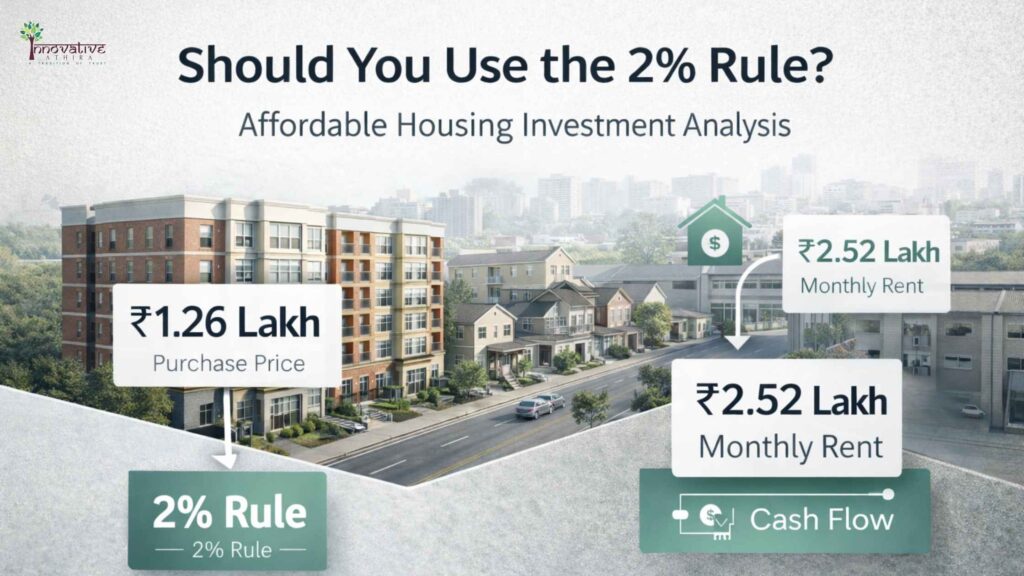
What is the 2% Rule and why is it relevant for Affordable Housing?
The 2% Rule suggests that a property’s monthly rental income should be approximately 2% of its total purchase price. While aggressive in premium markets, this rule aligns surprisingly well with Affordable Housing segments where entry costs are lower and rental demand is consistent. In cities like Bangalore, Affordable Housing is not merely a social concept—it is a practical investment category driven by workforce migration, industrial clusters, and long-term infrastructure planning. When applied carefully, the 2% Rule acts as a compass rather than a rigid formula.Why Affordable Housing is uniquely positioned for rule-based investing
Affordable Housing thrives on volume, velocity, and necessity. Unlike luxury housing, demand is not speculative. Tenants are end users—employees, technicians, logistics staff, and first-generation homeowners—who value proximity to work and connectivity over aesthetics.- Lower acquisition cost reduces downside risk
- Higher absorption rates ensure occupancy stability
- Rental demand remains resilient across cycles
How North Bangalore changes the Affordable Housing equation
North Bangalore is no longer an “upcoming” region—it is an executing growth zone. The presence of industrial parks, logistics hubs, aerospace clusters, and exhibition centers has created permanent housing demand. Locations such as BIEC, Madavara, and Nagasandra benefit from:- Metro and highway connectivity
- Proximity to employment nodes
- Planned layouts governed by BDA, BBMP, or BMRDA
Does the 2% Rule work for affordable plot investments?
Plots are often misunderstood in rental yield discussions. While plots do not generate rent immediately, their long-term potential lies in development flexibility and appreciation. In plotted developments close to employment zones, investors frequently unlock value through:- Incremental construction
- Joint development opportunities
- Future rental structures
Regulatory clarity as a hidden multiplier
One of the most overlooked factors in applying the 2% Rule is regulatory compliance. Layout approvals directly influence liquidity, resale value, and financing access. In North Bangalore:- BBMP governs layouts within city limits
- BDA covers strategic planning zones near BIEC
- BMRDA regulates outskirts such as Nelamangala
Why many investors fail when using the 2% Rule alone
The problem is not the rule—it is the isolation of the rule. Investors who apply it without considering micro-market rent ceilings, tenant profiles, and compliance often experience disappointment. Common pitfalls include:- Overestimating achievable rents
- Ignoring infrastructure timelines
- Buying in non-compliant layouts
How Innovative Developers and Promoters bridge the gap
Innovative Developers and Promoters operate at the intersection of market data, regulatory expertise, and on-ground execution. Their project selection philosophy is built around affordability, compliance, and future demand—not speculative hype. By focusing heavily on North Bangalore, they enable investors to:- Enter at accessible price points
- Align with real employment-driven demand
- Benefit from infrastructure-led appreciation
What happens if you delay your Affordable Housing decision?
Every growth corridor has a window. Miss it, and affordability disappears. Early investors in North Bangalore benefited from price discovery phases that no longer exist. Delaying action today may mean:- Higher entry costs tomorrow
- Lower yield-to-price ratios
- Reduced flexibility in layout selection
About Innovative Developers and Promoters
Innovative Developers and Promoters is a Bangalore-based real estate development firm specializing in compliant, strategically located residential layouts. With a strong footprint in North Bangalore—particularly near BIEC, Madavara, and Nagasandra—the company focuses on Affordable Housing solutions that balance livability, legality, and long-term investment performance. Their deep understanding of BBMP, BDA, BMRDA, and airport-region planning frameworks ensures that every project stands on a foundation of trust and transparency—qualities that Google, investors, and future buyers all recognize.Final thought: Should you use the 2% Rule?
Yes—but not blindly. Use it as a lens, not a verdict. When combined with the right location, regulatory clarity, and a developer who understands affordability at scale, the 2% Rule becomes a powerful ally. And in North Bangalore, that ally works best when guided by Innovative Developers and Promoters.Frequently Asked Questions
The 2% Rule can be a helpful screening tool for Affordable Housing investments, but it should not be used in isolation. In this segment, rental demand, price sensitivity, and location-driven growth matter more than hitting a strict numerical benchmark. Innovative Developers and Promoters guide investors to use the rule as a starting point while also factoring in infrastructure growth, livability, and long-term stability.
Many affordable projects do not meet the 2% Rule on paper, yet they still deliver sustainable income. This is because low-cost residential returns often rely on consistent occupancy, lower maintenance expenses, and steady tenant demand rather than aggressive monthly rent targets. Innovative Developers focus on designing projects that remain financially viable even when returns are moderate but predictable.
Plotted developments require a slightly different lens. While the traditional rule was created for built assets, investors can still analyze affordable plot rental yield by considering interim uses, nearby residential demand, and the potential for future construction. Innovative Developers structure plotted layouts in growth corridors so that even interim rental or lease value contributes meaningfully over time.
In affordable housing, location directly influences rental demand, resale liquidity, and tenant retention. Proximity to employment hubs, transport corridors, and social infrastructure can compensate for not achieving the 2% benchmark. Innovative Developers and Promoters prioritize micro-markets where long-term demand supports stable performance beyond short-term calculations.
Regulatory clarity is critical for risk management. Projects with strong approvals carry higher credibility, better financing options, and smoother resale. The BIAPPA approvals value lies in ensuring planned infrastructure alignment and legal transparency, which Innovative Developers emphasize to protect investors from future complications.
Rather than pushing a one-size-fits-all formula, Innovative Developers and Promoters combine market data, executed project insights, and buyer profiles to create realistic projections. Their approach balances rental income, capital appreciation, and affordability, helping investors make informed decisions even when the 2% Rule is only partially applicable.
For first-time investors, the 2% Rule works best as an educational benchmark rather than a strict pass-or-fail test. Innovative Developers help new buyers understand cash flow expectations, risk tolerance, and long-term horizons so that affordable investments remain practical, achievable, and aligned with real market behavior.